RPM Medicaid
Remote Patient Monitoring (RPM) for Medicaid
Medicaid covers remote patient monitoring — but on its own terms, with state-specific codes, prior authorization, and rules that Medicare-first platforms don't handle. RemoteCares is RPM built for Medicaid: authorization, real-time monitoring, and Medicaid billing in one platform, purpose-built for home health agencies.
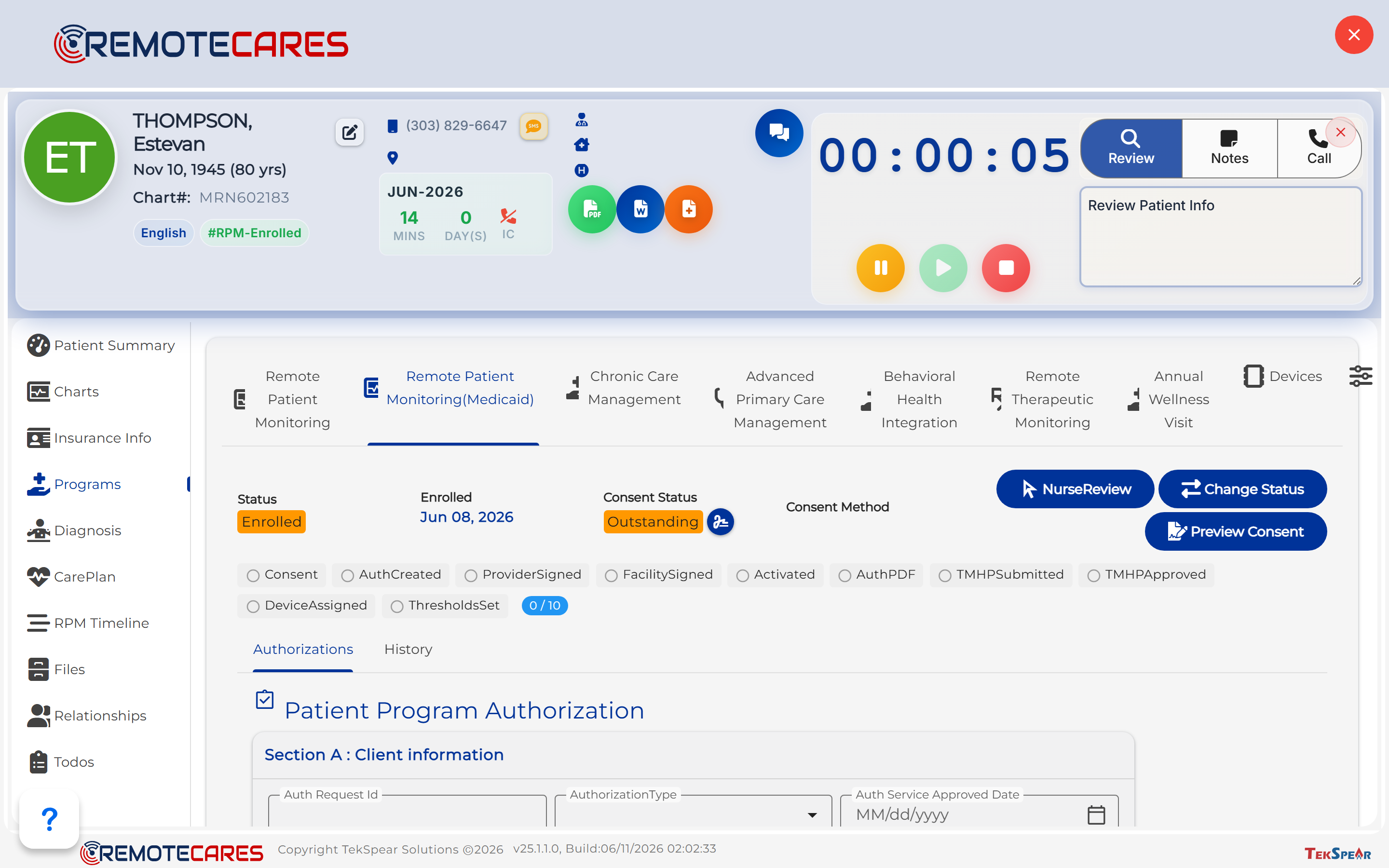
Does Medicaid cover remote patient monitoring?
Yes — many state Medicaid programs reimburse RPM, often under the name home telemonitoring. But unlike Medicare's nationwide CPT codes, each state defines its own benefit: which conditions qualify, who can bill, whether prior authorization is required, and which codes to use.
Texas is the clearest example. Texas Medicaid pays home health agencies monthly for telemonitoring under code S9110, with U1–U9 modifiers tied to the number of days a patient submits readings. RemoteCares runs that entire workflow — see TMHP telemonitoring & RPM for Texas Medicaid.
Medicaid RPM vs. Medicare RPM
Most RPM platforms are designed around Medicare's 99453/99454/99457/99458 codes and treat Medicaid as an afterthought. Medicaid RPM works differently — different codes, different billers, different documentation — and RemoteCares is built for it first.
| Medicare RPM | Medicaid RPM (Texas example) | |
|---|---|---|
| Codes | CPT 99453, 99454, 99457, 99458 | S9110 with U1–U9 modifiers |
| Who bills | Physician practices and clinics | Home health agencies |
| Rules set by | CMS, nationwide | Each state (TMHP in Texas) |
| Authorization | No prior authorization | Prior authorization typically required |
| What drives payment | 16 transmission days + review time | Reading-day tiers (1–5, 6–10, … 26–30) |
Most RPM platforms
- Built for Medicare
- Manual billing & exports
- Limited consent & engagement
- Generic clinical workflows
RemoteCares advantage
- Designed for Texas Medicaid (TMHP)
- Automated, TMHP-ready S9110 exports
- Digital consent + AI patient engagement
- Tailored for home care agencies
What Medicaid RPM pays: the Texas S9110 example
Under the Medicaid telemonitoring in Texas benefit, agencies bill S9110 monthly with a modifier based on reading days. RemoteCares tracks the reading days behind each modifier and rolls them into ready-to-submit claim exports.
| Code | Reading days | Monthly reimbursement |
|---|---|---|
| S9110-U1 | Initial setup | $50.00 |
| S9110-U2 | 1–5 reading days | $40.10 |
| S9110-U3 | 6–10 reading days | $80.19 |
| S9110-U4 | 11–15 reading days | $120.29 |
| S9110-U7 | 16–20 reading days | $160.38 |
| S9110-U8 | 21–25 reading days | $200.48 |
| S9110-U9 | 26–30 reading days | $240.57 |
Based on the TMHP S9110 fee schedule, billed monthly by reading days. Rates change — verify current amounts with TMHP.
Frequently asked questions
What is RPM Medicaid?
RPM Medicaid is Remote Patient Monitoring covered by a Medicaid program — patients use connected devices at home, and a care team reviews the readings and bills Medicaid for the monitoring. In Texas, the benefit is called home telemonitoring and is billed to TMHP under code S9110.
Does Medicaid cover remote patient monitoring?
Many state Medicaid programs cover remote patient monitoring, but the benefit name, eligible conditions, and billing codes vary by state. Texas Medicaid covers RPM as a home telemonitoring benefit billed monthly under S9110 with U1–U9 modifiers.
How is Medicaid RPM different from Medicare RPM?
Medicare RPM uses CPT codes 99453, 99454, 99457, and 99458 with nationwide rules. Medicaid RPM is defined state by state — Texas, for example, uses a single code (S9110) with modifiers based on reading days, is billed by home health agencies, and requires prior authorization. Most RPM platforms only handle the Medicare model.
What code is used to bill Medicaid for RPM?
It depends on the state. Texas Medicaid uses S9110 with U1–U9 modifiers, billed monthly based on device setup and the number of reading days. Other states may use Medicare-style CPT codes or their own telemonitoring codes.
Who can bill Medicaid for remote patient monitoring?
In Texas, home health agencies deliver and bill the telemonitoring benefit with a physician order and prior authorization. RemoteCares automates that workflow end to end — authorization, monitoring, and S9110 claims.
What software supports Medicaid RPM billing?
RemoteCares is built specifically for Medicaid RPM — TMHP prior authorization, reading-day tracking, and S9110 / U1–U9 claim exports — alongside Medicare RPM, CCM, RTM, and the rest of the chronic-care stack.
Launch RPM for your Medicaid patients
A short walkthrough with your programs, devices, and billing in mind. No pressure — just a clear look at the platform.