CMS Is Pushing Care Into the Home. The ACCESS Model Is the Proof.
RemoteCares Team · August 28, 2026
For years, “healthcare is moving to the home” has been a conference-slide claim. This summer it became a payment model.
On July 5, 2026, the CMS Innovation Center launched the ACCESS Model — Advancing Chronic Care with Effective, Scalable Solutions — a 10-year voluntary model in Original Medicare that pays organizations for outcomes achieved through technology-enabled chronic care. More than 150 organizations were accepted for the first performance period. Almost none of them are hospitals.
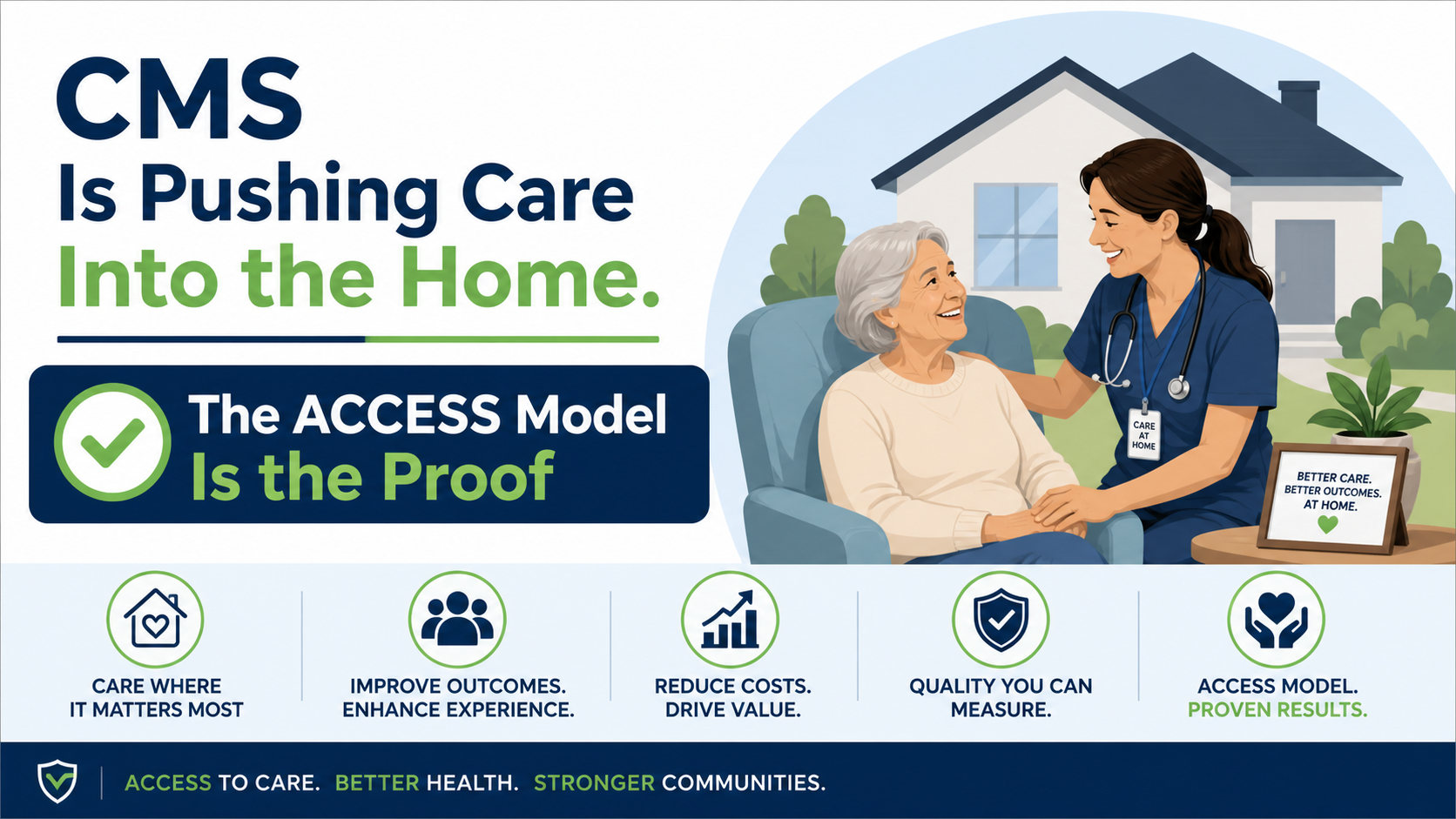
That last detail is the story. CMS didn’t build a model to help hospitals reach further into the home. It built a model that assumes the care happens in the home, continuously, and pays only if the patient’s numbers actually move.
What the ACCESS Model actually is
Strip away the acronym and ACCESS is a bet: that continuous, technology-supported management of chronic disease outside the clinic produces better numbers than episodic office visits — and that CMS should pay for the numbers rather than the visits.
The mechanics, in plain terms:
- Four condition tracks. Early cardio-kidney-metabolic (hypertension, prediabetes, obesity); cardio-kidney-metabolic (diabetes, chronic kidney disease, cardiovascular disease); musculoskeletal (chronic pain); and behavioral health (depression and anxiety).
- Who can participate. Medicare Part B–enrolled providers or suppliers, excluding DMEPOS and laboratory suppliers, each with a designated physician clinical director accountable for quality and compliance.
- How patients join. Voluntarily — either directly, or by referral from their own physician, who then receives electronic updates on the patient’s progress.
- A 12-month care period, with a follow-on period available in some tracks if the patient stays aligned and eligible.
The payment is the point: no CPT codes, no visits
Here is what makes ACCESS different from every RPM and CCM billing conversation you’ve had.
There are no CPT codes. Participants receive an Outcome-Aligned Payment (OAP) — an annual allowed amount per aligned beneficiary, paid across the care period rather than earned per service. Per ArentFox Schiff’s analysis of the payment amounts CMS published for care periods beginning July 5, 2026 through December 31, 2027, the annual allowed amounts are:
| Track | Initial 12 months | Follow-on |
|---|---|---|
| Early cardio-kidney-metabolic | $360 | $180 |
| Cardio-kidney-metabolic | $420 | $210 |
| Musculoskeletal | $180 | — |
| Behavioral health | $180 | $90 |
Modest numbers. But the structure matters more than the amount: CMS withholds 50% of the Medicare portion during the care period and releases it only at reconciliation, based on whether patients hit defined clinical targets — blood pressure, weight and BMI, A1c, LDL, validated pain and function scores, standardized behavioral health symptom measures. For the first performance period, at least 50% of a participant’s aligned beneficiaries must meet all required outcome targets for full payment. A further adjustment reduces payment when aligned patients are getting substitute services from other Medicare providers.
And the tradeoff runs both ways: in months when ACCESS payments are made, participants generally may not separately bill Medicare for overlapping care-management services for that same condition — though unrelated services still bill normally.
So: half the money is contingent on the patient’s A1c or blood pressure actually improving, and you give up the fee-for-service care-management revenue for that condition while you try. That is not a monitoring program. That is being paid to change an outcome.
Two CMS signals that look contradictory — and aren’t
Read this alongside our coverage of the CY2027 Medicare proposed rule, where CMS proposed tightening fee-for-service RPM: in-house staffing, a required initiating visit, lower device payments. One hand tightens FFS monitoring; the other launches a 10-year model built entirely on monitoring at home.
They’re the same message. CMS is not skeptical of remote monitoring — it’s skeptical of monitoring that bills without producing anything. The OIG findings behind the CY2027 proposals described enrollment mills and incomplete service components. ACCESS is the mirror image: no codes to game, no payment for a device that transmits into a void, and half the money held back until the patient’s numbers move.
The through-line across the CY2026 final rule, the CY2027 proposals, and ACCESS is consistent — CMS will keep paying for care in the home, and will keep raising the bar on proving it worked.
What this means for Texas Medicaid agencies
Direct answer first: ACCESS is a Medicare Fee-For-Service model. It does not change Texas Medicaid. It does not touch S9110, the U1–U9 reading-day tiers, TMHP prior authorization, or who may deliver the home telemonitoring benefit. If you bill TMHP, nothing in your workflow changes because of ACCESS. (For the Texas program itself, start with TMHP RPM and how Medicaid RPM differs from Medicare RPM.)
Three things still make it worth your attention.
1. The payer pledge reaches beyond Medicare. Alongside the model, private payers representing roughly 165 million members across Medicare Advantage, Medicaid, and commercial coverage signed the ACCESS Payer Pledge — committing to offer payment arrangements aligned with the model’s core principles by January 1, 2028. Signatories include Centene, Humana, CVS Health, Cigna, UnitedHealthcare, and a long list of Blues plans. Centene is the parent of Superior HealthPlan, a Texas Medicaid managed care organization. To be precise: that is a corporate-level pledge, not an announced change to any Texas Medicaid or TMHP policy — and it should not be read as one. But when the companies operating Medicaid managed care nationally commit to outcome-aligned payment, the direction of travel becomes hard to miss.
2. The agency model is the one CMS is describing. ACCESS assumes a team that sees a patient’s data continuously, intervenes between visits, and is accountable for whether the trend improves. Texas home health agencies running telemonitoring already do that — with their own nurses, under a physician order, in the patient’s home. What ACCESS adds is the discipline of proving it: baseline measures captured at enrollment, outcomes captured at the end of the period, and a documented line between the two.
3. Outcome data is the asset you’re not capturing yet. Reading days and management minutes get you paid under S9110 today. Under any outcome-aligned arrangement, the questions become different: what was this patient’s blood pressure at enrollment, what is it now, and what did your team do in between? Agencies that can answer that from their platform — rather than reconstructing it from chart notes — will be ready when a Texas MCO or a Medicare-facing partner asks. Agencies that can’t will spend a quarter building a report.
The practical takeaway
You don’t need to apply to ACCESS. Most Texas home health agencies aren’t the right participant type, and the Medicaid benefit you bill is unaffected.
What you should take from it is the direction: CMS has now committed a decade to the proposition that chronic disease is managed at home, continuously, with technology — and that the payment should follow the outcome. Every rule since 2026 has pointed the same way. The programs positioned for that shift are the ones already capturing, as the work happens, both the activity and the result: the readings, the minutes, the interventions, and the trend line that shows whether any of it helped.
That’s true whether the payer is CMS, a Medicaid MCO, or TMHP under S9110. The documentation that survives an audit today is the same documentation that earns an outcome payment tomorrow.
This is an educational overview of a CMS Innovation Center model, not billing or legal advice. Model terms, payment amounts, and performance targets may change; Texas Medicaid (TMHP) policy is separate and unaffected by ACCESS. Always confirm current requirements with authoritative sources and your own compliance team before making program changes.
Sources: CMS ACCESS Model; ArentFox Schiff — CMS Innovation Center Unveils ACCESS Model; ArentFox Schiff — ACCESS Model Payment Rates and Performance Targets; Longyear Health — Analyzing the CMS ACCESS Model Participants; CMS — Major Health Plans Join ACCESS Payer Pledge.