How AI Can Reduce Administrative Work in Home Health
RemoteCares Team · August 5, 2026
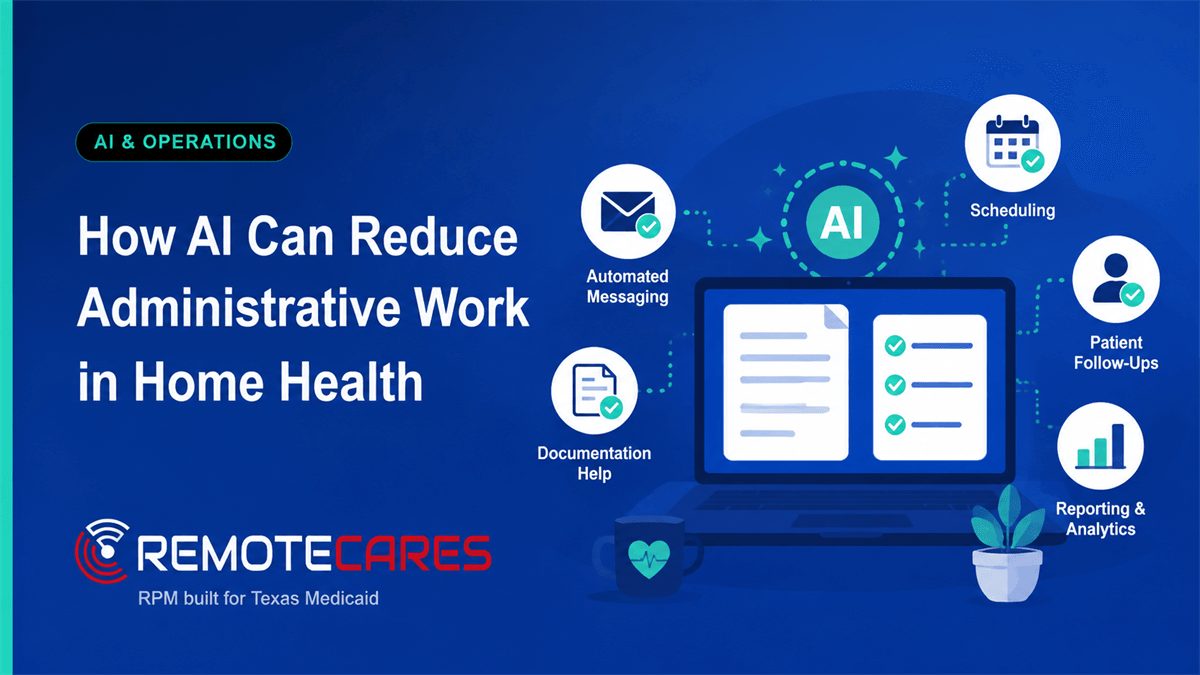
Ask anyone who runs a home health program where the hours go, and the answer is rarely “patient care.” It’s phone tag. It’s building the same patient list three different ways for three different questions. It’s translating a message, copying it into the chart, and calling back to confirm. Administrative work is the tax every care program pays — and it’s the part AI is actually good at. Not the caring. The clerical work around the caring.
Here’s where that plays out in practice, based on how we’ve built it into RemoteCares.
The questions that never needed a nurse
A large share of inbound patient messages aren’t clinical at all. What time should I take my reading? Where do I find my care plan? Did my appointment move? Every one of those, answered by a human, is a few minutes of interruption — multiplied across a patient panel, it’s someone’s whole afternoon.
An AI companion can answer these directly, immediately, and in the patient’s own language. When a patient chats in Spanish or Vietnamese, the care team still gets an English copy of every reply in the record, so nobody is left wondering what the assistant said. The conversation lives in the same thread the care team uses — nothing to copy, nothing to re-document.
The critical design point: the assistant only answers safe-zone questions. Anything clinical is held for a human — we wrote about how that boundary works in AI Triage, Done Safely. The admin work disappears; the clinical judgment doesn’t move an inch.
Finding patients without building a report
“Which of our diabetic patients are struggling with their glucose?” is a one-sentence question that traditionally becomes a fifteen-minute report-building exercise — pick the filters, join the columns, export, sort.
With a records assistant, the sentence is the query. Ask in plain English, and the answer comes back as a list of patients, each explaining why it matched — risk level, compliance, last reading, days until an authorization lapses — one click from the chart. The same assistant sits docked beside a nurse’s work all day: look up a patient, pull a cohort, check what’s in the queue, without leaving the screen they’re on.
Nobody’s job was “build the report.” The report was in the way of the job.
Outreach that runs itself
Routine engagement — wellness check-ins, gentle nudges when readings stop arriving, reminders tied to the care plan — is exactly the work that slips when a team gets busy, and exactly the work software never forgets. Scheduled AI outreach keeps the conversation going between visits, and every response lands back in the patient’s record as it happens. The team stops maintaining call lists and starts working from what the outreach surfaced.
Escalations that route themselves
When something genuinely needs a clinician, the administrative question becomes who sees it, and how fast? A message that sits in a shared inbox is an administrative failure with clinical consequences.
In RemoteCares, a clinical message becomes an escalation with an urgency and a response window — a visible countdown, not a vague intention. It reaches the right care-team member where they actually are, including push notification on their phone, and when someone acknowledges or resolves it, the whole team sees that it’s handled. No forwarding, no “did anyone call them back?”, no second spreadsheet tracking the first one.
What we deliberately don’t automate
The fastest way to lose a care team’s trust in AI is to let it wander into clinical territory. So the boundary isn’t a guideline — it’s built in. The assistant cannot give clinical advice; symptom questions are held for a human through a fixed path no prompt can talk its way around; and every AI interaction is visible to the team, in the record, in English. Administrators can see usage across the program, so the AI is never a black box operating beside the chart — it’s part of it.
That discipline is what makes the rest of this worth doing. An assistant a team has to double-check saves nothing.
The point isn’t fewer people
None of this replaces a nurse, a care manager, or a scheduler. It replaces the part of their day that never required their license: the lookup, the list, the translation, the reminder, the forwarding. In home health, where every administrative hour competes directly with a patient-facing one, that’s not a convenience — it’s capacity. The programs that get this right won’t be the ones with the cleverest AI. They’ll be the ones that gave the clerical work to software and the time back to care.